
What: On April 23, 2026, the U.S. Department of Labor (DOL) issued a proposed rule on joint employer liability. When an individual works for two or more companies simultaneously, this proposed rule determines which employer is responsible for complying with federal labor laws for minimum wage and overtime. DOL is creating a federal standard for joint employer definition because there has been no guidance for employers on this subject since 2021. This rule will affect small businesses that use staffing companies, as well as those in franchisor-franchisee, vendor-supplier, and contractor-subcontractor arrangements.
Why: The proposed joint employer definition applies to DOL’s Fair Labor Standards Act (minimum wage overtime), Family and Medical Leave Act (unpaid job-protected leave), and Migrant Act (migrant employment rights). There is a separate federal standard for the National Labor Relations Act (union rights) that has a narrower definition of the joint employer relationship, which is not impacted by this proposed rule.
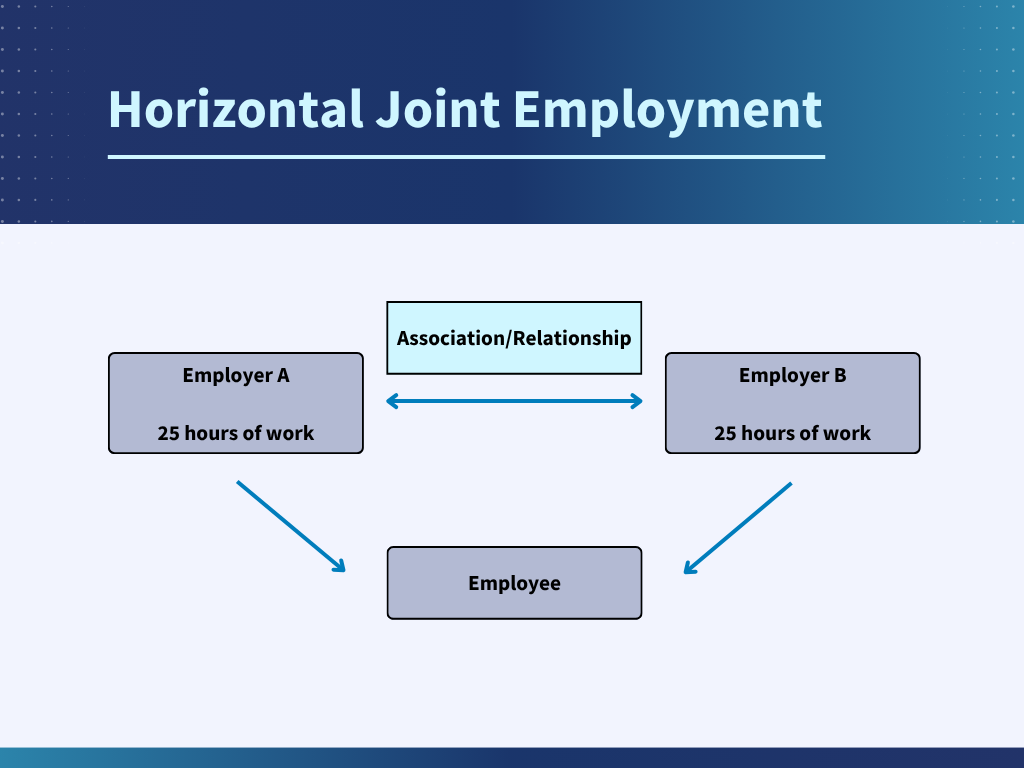
The rule discusses two kinds of joint employment: vertical joint employment and horizontal joint employment (as shown in Figures A and B).
The proposed rule also states that certain business models and practices do not necessarily make a company a joint employer, including:
- operating as a franchisor or entering into a brand and supply agreement;
- contractual agreements requiring compliance with general legal, health, and safety standards.
- contractual agreements requiring quality control standards:
- providing an employee handbook, offering health or retirement plans, jointly participating in an apprenticeship program, or any other similar business practice.
Action: Read the proposed rule and submit comments by the June 22, 2026, deadline.
FIGURE A
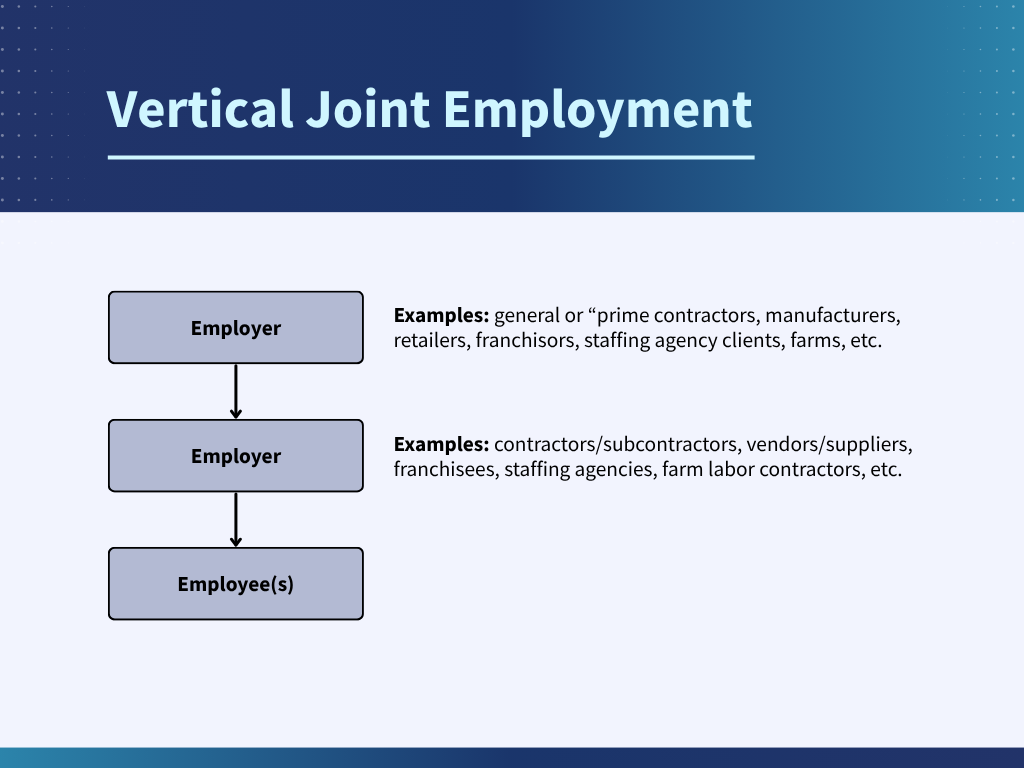
FIGURE B
In a vertical employment scenario, there are four factors to apply to determine whether a person is a joint employer:
- Hires or fires the employee;
- Supervises and controls the employee’s work schedule or conditions of employment to a substantial degree;
- Determines the employee’s rate and method of payment; and
- Maintains the employee’s employment records.
No single factor is dispositive in determining joint employer status under the Fair Labor Standards Act, as the determination will depend on all of the facts in a particular case.
Reserved control: The rule states that while the potential joint employer’s ability, power, or reserved right to act in relation to the employee is relevant for determining joint employer status, the actual exercise of control is more relevant in this determination.
Horizontal joint employment is when two employers are sufficiently associated with respect to the employment of the worker, so they are joint employers and liable for overtime hours and under the Fair Labor Standards Act.
For example, an individual works at two different places at a golf course, 25 hours as a caddy for golfers and 25 hours as a cook at the restaurant. If both places are owned by the same company or are sufficiently associated, they are both joint employers. The individual would be working 50 hours and entitled to 10 hours of overtime. Both the restaurant and the golf course would be potentially liable for the overtime hours.
The employers will generally be sufficiently associated if:
- There is an arrangement between them to share the employee’s services.
- One employer is acting directly or indirectly in the interest of the other employer in relation to the employee; or
- They share control of the employee, directly or indirectly, by reason of the fact that one employer controls, is controlled by, or is under common control with the other employer.
Is your small business or entity being impacted by a proposed rule? If yes, write a comment letter to the proposing agency.