

BLOG
A Veteran’s Vision: Service and Leadership at Vision Flooring
PUBLISHED: November 14, 2025
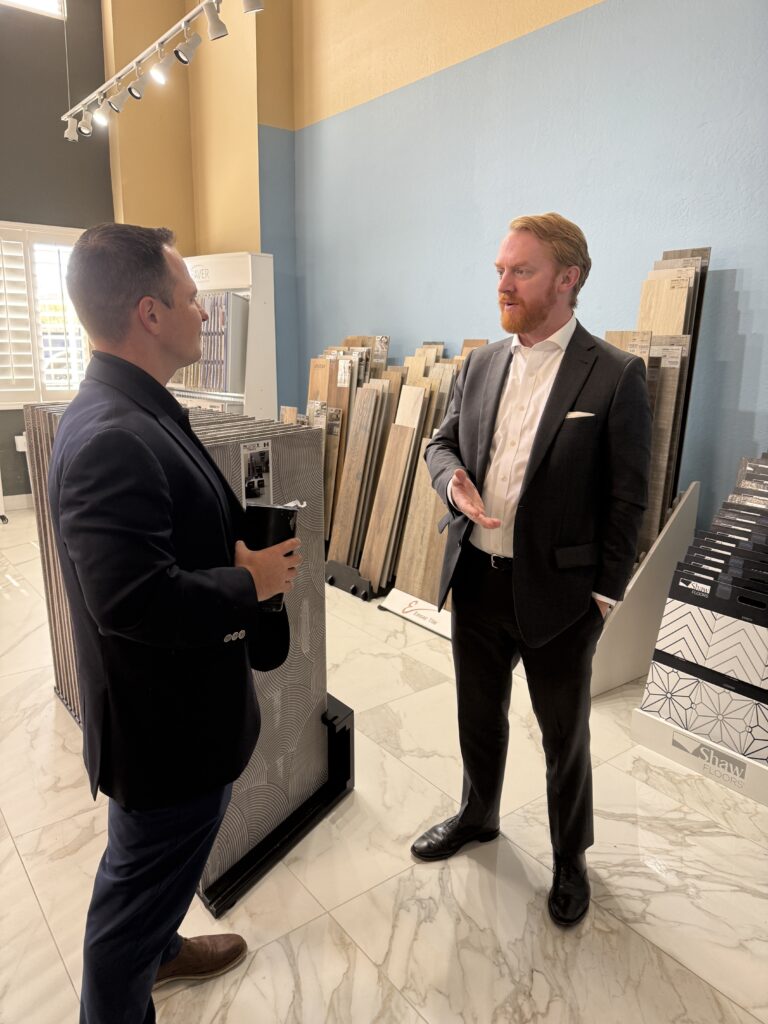
In honor of Entrepreneurship Month and Veterans Day, the Office of Advocacy’s Deputy Chief Counsel Chip Bishop and Director of National and Regional Affairs Tom Rossomando met with Vision Flooring CEO Shane Levinson, an Army veteran, in Chandler, Arizona. Together, they viewed his company’s beautiful showroom and spent time in the employee break room to hear about his journey.
Like the more than 1.6 million other veterans who own small businesses in the United States, Levinson pivoted from serving his country to serving his customers. The mission of Vision Flooring is to “deliver customer service experience so exceptional that you can’t help but tell your friends about it.”
Levinson and his team believe in treating every client like family. While many flooring sellers operate exclusively online, the Vision Flooring team sees being an in-person presence in the community as a way to connect more directly.
Their business, a father and son team, was created after Levinson’s enlistment in the United States Army ended, having deployed to Iraq and Afghanistan. They built Vision Flooring in response to identifying that most of the industry relied on an outdated business and marketing model and that by providing a cutting-edge online experience they could better serve customers. Levinson quickly implemented what he learned about adaptation, leadership, and discipline from the military into his business model.
To that end, Vision Flooring has adopted and extensively integrated AI to bolster its quality of customer service. As one of the 8.8% of small businesses experimenting with AI, Levinson has found that the tools have helped increase sales, improve customer service and sales techniques, and create efficiencies to keep costs low.
But business has not been without its challenges. Levinson recently faced regulatory enforcement about an issue he didn’t even know about. Small businesses face thousands of intertwining and sometimes contradictory regulations; at the same time, they strive to grow their business. Levinson joked that he and his friends, who also own businesses, like to say, “To be a small business owner is to be a criminal.”
Thankfully, the regulatory enforcement he faced turned out to be a mistake by the agency, so he didn’t have to pay the $5,000 fine. But that wasn’t determined until he spent countless hours doing his own investigation, complying with the inquiry, and hiring a specialist.
Levinson noted that in recent years, enforcement of rules has seemed more punitive in nature than educational, which he sees as detrimental to encouraging entrepreneurship. He shared several specific issues that the Office of Advocacy has brought back to the workshop in Washington, DC, where Advocacy works with regulators on small businesses’ behalf.
Levinson has made a career out of pivoting when encountering challenges, in the military and in business. He said that increased competition has prompted him to improve his marketing strategy, which has resulted in growth rather than decline. And he said that supply chain constraints have provided an opportunity to sell more Made in America products.
When Levinson sees a problem, he immediately starts looking for a solution. This is emblematic of the millions of other veteran small business owners across America. We can be proud of their service in the armed forces and the US economy. Advocacy will keep working to remove these harmful barriers so entrepreneurs like Shane Levinson can keep building this great country.